
 Dec 03, 2025

Here at Edison, urgency has been top of mind for the past few months. We centered our annual CEO Summit around healthy urgency (and were even forced to practice what we planned to preach when the threat of a tropical storm prompted us to quickly reimagine the event in a virtual format) and planned the Executive Leadership Team (ELT) Summit to build on that same topic.
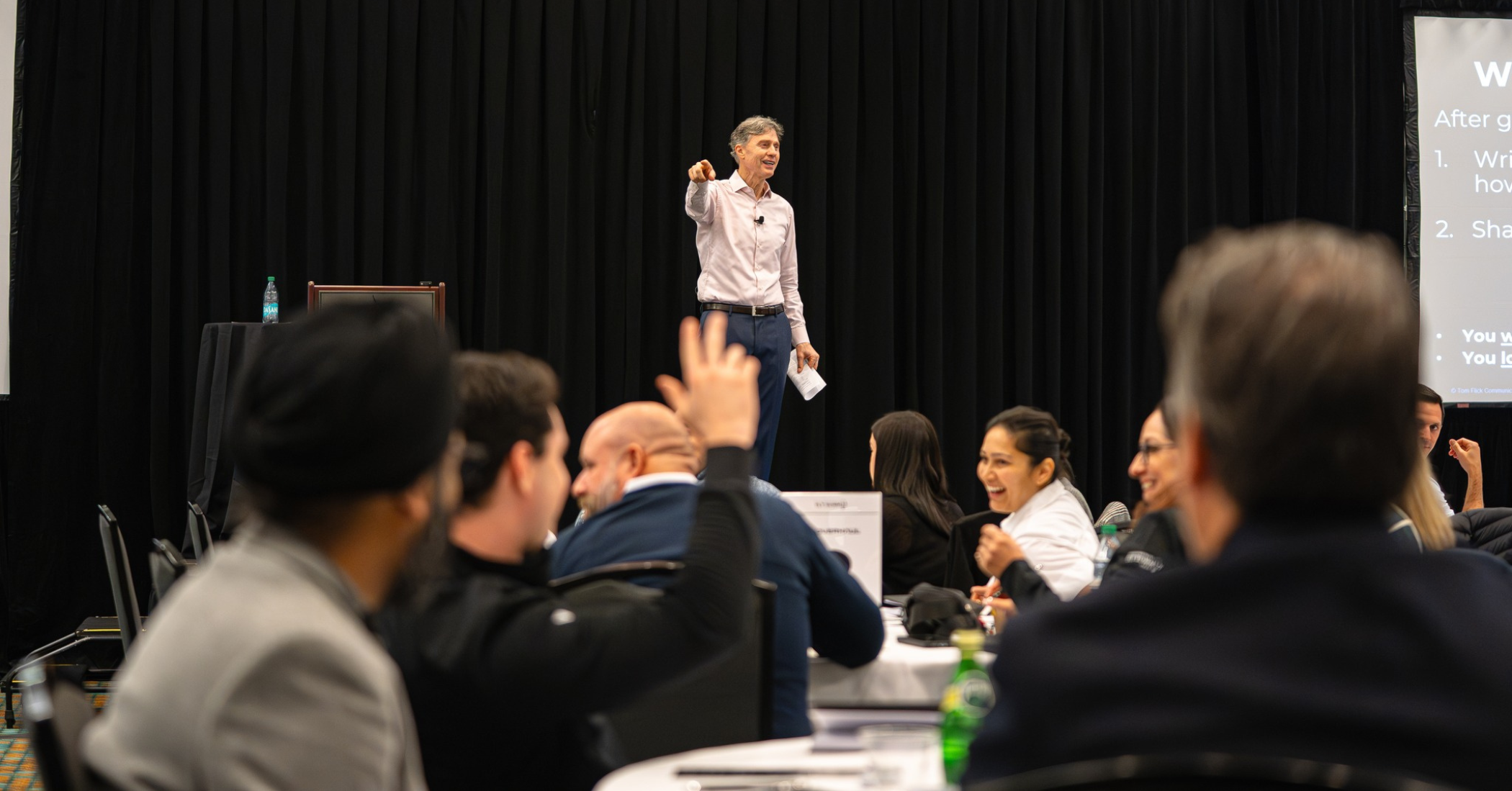
I spent hours searching for a keynote speaker who could help us convey to ELT members the importance of balancing speed, clarity, and sustainability (a practice we’ve labeled as “healthy urgency”) to drive lasting growth. Fast forward to the actual event, and I found myself sitting in a large conference room in the Music City Convention Center, surrounded by seventy executives from across the Edison Partners portfolio: CXOs spearheading their companies’ Go to Market, Finance, Product & Technology, and HR functions. Before us stood the man hired for the job: executive leadership coach and former NFL quarterback, Tom Flick.
Tom and I had spoken several times in the weeks leading up to the ELT Summit, so I was familiar with his “true urgency” framework and largely knew what to expect from his content. What I couldn’t be certain of was how deeply his keynote and workshop would resonate with our portfolio executives, or how effective it would be in hammering home the criticality of healthy urgency.
Much to my delight, I watched over the next three hours as our CXOs leaned into the workshop and engaged meaningfully with the content—sharing their experiences at their respective workplaces and learning from Tom, and from each other, about how to leverage healthy (or “true”) urgency to go further in their businesses.
Here are three key takeaways from Tom’s presentation:
1. Growth-stage business leaders are up against real, meaningful antagonists.
Tom encouraged participants to think of themselves as protagonists and to think of their business challenges as antagonists. According to him, the two greatest antagonists leaders face in growing their businesses are complacency and false urgency.
Complacency—which Tom defines as “a feeling of self-satisfaction with danger looming around the corner”—occurs when people think that what they are doing is just fine. The issue (if there is one) lies externally — with another employee, another team, or uncontrollable market forces. When individuals and teams get complacent, they resist necessary change and ultimately hinder the growth of the company. They accept the status quo and settle for “good enough” when “better” or “best” are accessible.
False urgency is frenetic behavior that looks productive and keeps people busy, but doesn’t actually move the needle. Think: constant meetings, random new task forces, or a shortlist of “sprints” that inexplicably never cross the finish line. False urgency keeps people in survival mode and inevitably leads to burnout. It maintains the illusion of progress (because if everyone is heads down and locked in, then surely important work is getting done), but ultimately stifles growth because it pulls people away from the work that actually matters.
By recognizing these antagonists, Tom argued, business leaders can better equip themselves and their teams to do meaningful, value-add work.
2. True (or “healthy”) urgency is more than a framework. It’s an asset.
In the fight against complacency and false urgency, growth-stage CxOs have a formidable tool in their toolkit: true urgency (used interchangeably with healthy urgency). Tom defines true urgency as a state in which “people come to work every day determined to seize real opportunities and avoid real hazards.” It’s the intentional and concerted effort to remain alert, drive internal alignment, make progress every single day, and, ultimately, to win.
True urgency counteracts complacency because it demands high awareness of both internal and external forces, and thus prompts people to see around corners. True urgency counteracts false urgency because it requires the elimination of low-value activities in favor of those that will actually help the company win. When leaders cultivate a culture of true urgency, they empower their teams to focus on the work and the opportunities that will lead the company to success.
3. The speed of the leader determines the rate of the pack.
Most of us have heard the saying, but what does it mean in a growth-stage business context?
According to Tom, it means that CXOs and other people leaders are directly responsible for driving true urgency amongst their teams. It reminded me of Steve Schloss’ urgency thermostat (pictured below), and his assertion that the CEO ultimately determines the “temperature” of the rest of the organization.
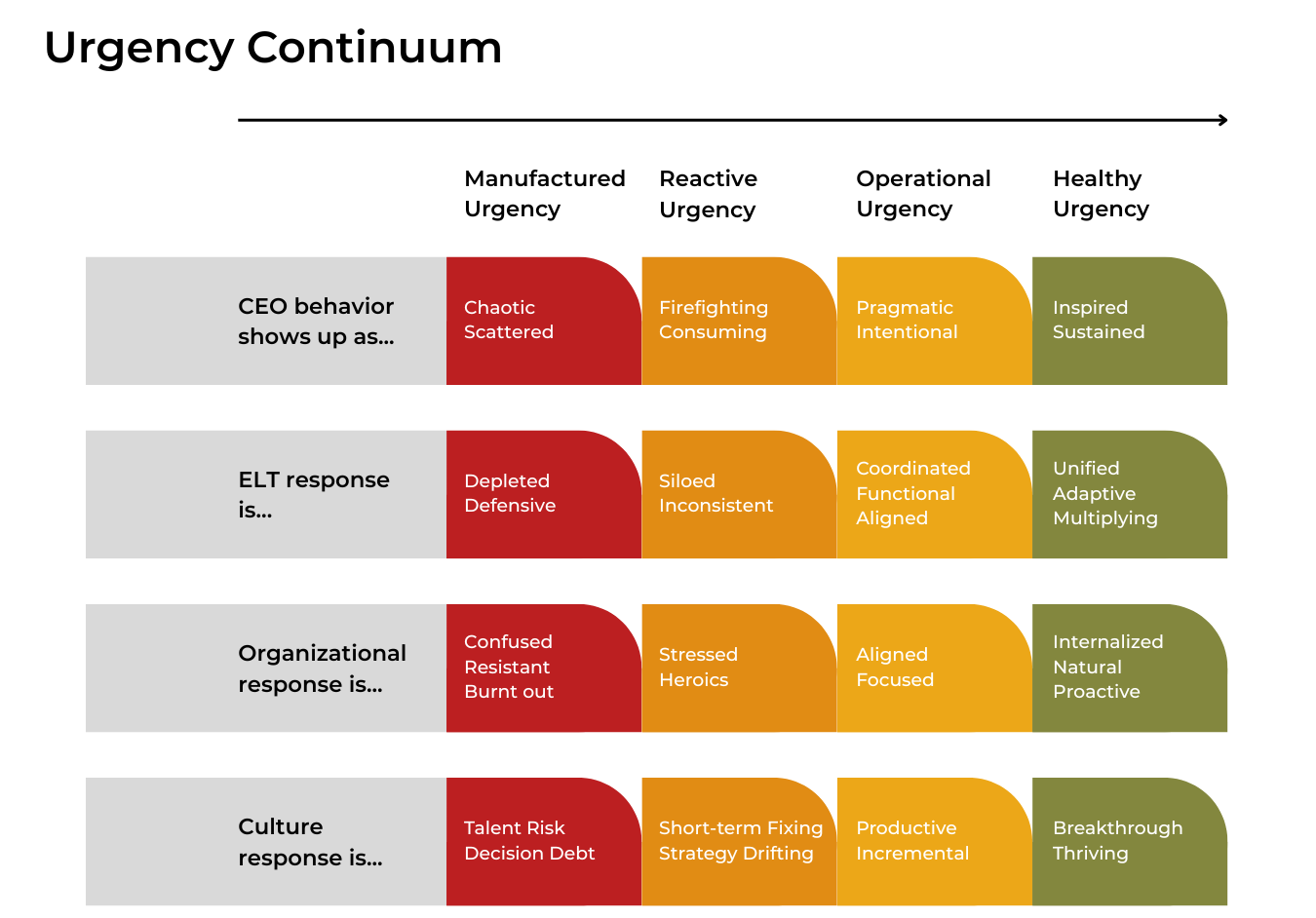
For CXOs, setting the temperature looks like:
- Choosing your words carefully. As Tom mentioned to our group, words both perpetuate and predict the future. Ever aware of this truth, effective leaders replace killer phrases (“We’ve never done it that way.” “That just won’t work.” “Let’s be practical.”) with igniter phrases (“We’re on the right track.” “Keep up the good work.” “I made a mistake."). They use words to shape the reality of their teams and to empower others to seize the opportunities in front of them.
- Being intentional about building your team. According to Tom, there are four levels of teams: teams in name only, good teams, great teams, and legacy teams. CXOs should strive to build legacy teams, where each team member is aligned with and committed to a clearly and continuously communicated vision.
- Leading the way. Growth-stage CXOs cannot (and should not) go it alone, but they can model the type of work, character, and intention they expect from their teams. Tom calls this “leadership mastery” — being a leader who serves others, establishes relationships built on trust, consistently takes action, and helps others win. Leaders who “go first” in modeling the practices of true urgency empower their teams to follow in their footsteps.
Succeeding at the growth stage means fighting against complacency and false urgency and moving forward, instead, with true or healthy urgency. It means being the type of leader that uplifts and empowers, not just with words, but with intentional action. And sometimes, succeeding in a growth-stage business means taking a page out of the playbook of a retired NFL quarterback, from whom you just might learn more than you think.
