

 Nov 10, 2026

We hosted our annual CEO Summit at West Point a few years ago, where a colonel shared a line the Army teaches its cadets: you have the team you deserve. Not long ago, an executive I work with turned it around on me. They said they didn’t deserve their team because it was that good.
If you’re running a company growing from $10-$50 million toward $100 million, earning a team like that comes down largely to whether you’ve moved from hiring reactively to hiring intentionally. Chris Sugden and I dug into this on a recent episode of Edison Partners' Electrifying Growth podcast, which you can listen to here.
This year, we hosted CEO Summit at Duke University. The content focused on leading in the age of AI, and nearly every session circled back to talent. My biggest takeaway for CEOs was how this affects the hiring process: AI raises the cost of a reactive executive hire.
When Your Founder Instincts Work Against You
If you're in that $10-50M range and you founded the company, you’re probably an excellent reactive hirer. You know how to put someone ready for this stage into the seat your business needs filled this quarter. But I’ve rarely met a founder who’s equally good at hiring intentionally.
The hardest part is personal. You’re used to touching and fixing everything, while the next stage asks you to depend on a team, which can feel like a quiet demotion. Duke University Professor Tony O’Driscoll, who runs the university’s Chief AI Officer program, reminded us of Peter Drucker’s observation that the bottleneck is always at the top of the bottle. Thus, your next executive hire should take decisions off your desk. You need someone you’ll actually let decide.
Four Questions to Consider Before Opening A Search
Before any executive hire, I encourage you to answer these deceptively simple questions:
- Why this role?
- Why now?
- Why this level?
Since the summit, I’ve added a fourth: Why a person? Answered honestly, these questions pull you away from what you think you’re supposed to do and towards what your business needs now.
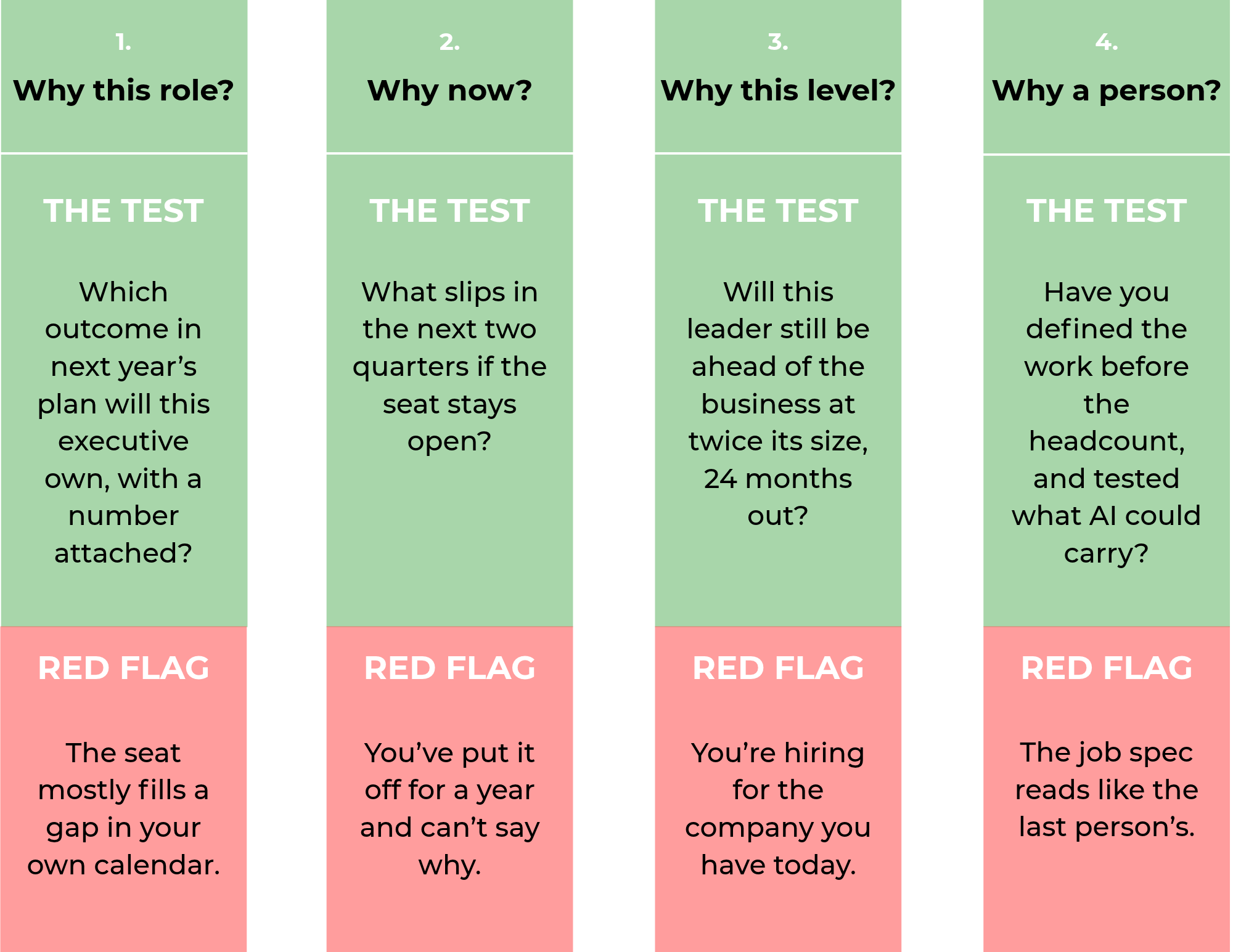
The fourth question matters more every quarter. Workforce planning is moving from headcount to capacity, where you define the work first, and choose the resource second. For example, Shopify now asks managers to show that AI can’t do the work before approving a hire. You don’t need the policy to borrow the discipline. Often, the answer will still be a person, and you’ll know exactly why.
The third question, "Why this level?" needs a longer horizon than most CEOs will give it. Too many times, I've seen executives replaced for past performance, when the real question is what the next two years will demand and who can get you there. Professor O'Driscoll shared an organizational network analysis suggesting that 30-40% of the leaders others would follow in a tough stretch aren’t on the succession plan. You need to look inside before you look outside: your org chart won’t show you those hidden stars, but asking your team who they turn to when something breaks usually will.
If you do choose to hire outside, a Hogan Assessment can give you an early read on how likely a candidate is to derail, as well as perform. Expect a great hire to change your job, too. When you bring in someone more accomplished in their function than you are, you’ll have to raise your own bar to get the best from them.
Outside CEOs: you don't have an advantage here. I recommend unlearning old habits and keeping the founder on speed dial for your first 90-180 days. They know the customers, the product, the rituals, and the board in ways you can’t absorb in a few months.
Use Your Board, and Build a Personal One
Ultimately, confidence differentiates the CEOs who hire well.
A surefire way to feel confident is seeking your board’s counsel. Bring them talent decisions before you make up your mind, lean on them for introductions and candid second opinions, and prioritize agreeing with them on near- and medium-term expectations. Ask them to make room for experimentation, since incentives tied tightly to near-term numbers quietly discourage it, and mismatched expectations can create pressure that rarely produces sustained performance.
Then, stop performing for them and put your reputation behind the hire. If it doesn’t work out, act and move on instead of defending the original call.
Professor Shep Moyle, who coaches CEOs at Duke after three decades running a global company, takes this a step further. He urges every CEO to keep a personal board of directors: 4-5 truth-tellers willing to ask inconvenient questions.
As for the executive who said they didn’t deserve their team? I’d argue the point. A team like that was built one deliberate decision at a time, long before anyone outside the company noticed. That level of intentional effort is rare. And, not surprisingly, is reflected in their operating results.
Frequently Asked Questions
How should growth-stage CEOs approach executive hiring as their companies scale?
Growth-stage CEOs should shift from reactive hiring to intentional workforce planning. Before opening an executive search, leaders should ask four questions: Why this role? Why now? Why this level? Why a person? This framework helps CEOs align executive talent decisions with long-term business needs, leadership capacity, and opportunities to leverage AI rather than simply filling immediate gaps.
How is AI changing executive hiring and workforce planning?
AI is shifting workforce planning from headcount to capacity. Rather than automatically hiring to address a business need, CEOs should first define the work and determine whether it requires a new executive, existing talent, or AI-enabled capabilities. This approach helps growth-stage companies allocate resources more effectively, improve operational efficiency, and make more strategic hiring decisions.
What role should the board of directors play in executive hiring decisions?
Boards should serve as strategic advisors throughout the executive hiring process, helping CEOs evaluate leadership needs, identify qualified candidates, and align expectations for long-term performance. CEOs should engage board members before making hiring decisions, seek candid feedback, and establish clear near- and medium-term objectives for new executives. This alignment strengthens accountability and reduces the risk of costly leadership missteps.
