
 Nov 19, 2026

What would happen if three entrepreneurs launched a company tomorrow that did exactly what your business does today? They have no legacy code, limited overhead, and no established processes to work around. They're building from scratch with AI embedded in how they develop products and serve customers. And they're targeting the same customers you've spent years acquiring and retaining.
For growth-stage CEOs, this scenario presents a challenge worth considering as they finalize their 2027 operating plans. AI-native competitors have the potential to disrupt established businesses by fundamentally rethinking how products are developed, delivered, and monetized. The question is whether your business is positioned to compete with a company designed around AI from day one.
How Should Growth-Stage CEOs Compete With AI-Native Startups?
Growth-stage companies have spent years building products, acquiring customers, and developing the infrastructure needed to scale. Those investments create competitive advantages, but they can also introduce complexity that makes it harder to adapt as technology evolves.
Most established businesses approach AI by identifying opportunities to improve existing operations. They evaluate tools that increase employee productivity, streamline workflows, or reduce operating expenses. These investments can generate meaningful returns. However, AI-native competitors are approaching the same markets with fundamentally different assumptions about how a business should operate.
Without legacy infrastructure or established processes, these companies can design their products and operating models around what AI makes possible today. They may be able to bring new capabilities to market faster, deliver more personalized customer experiences, or operate with significantly leaner teams.
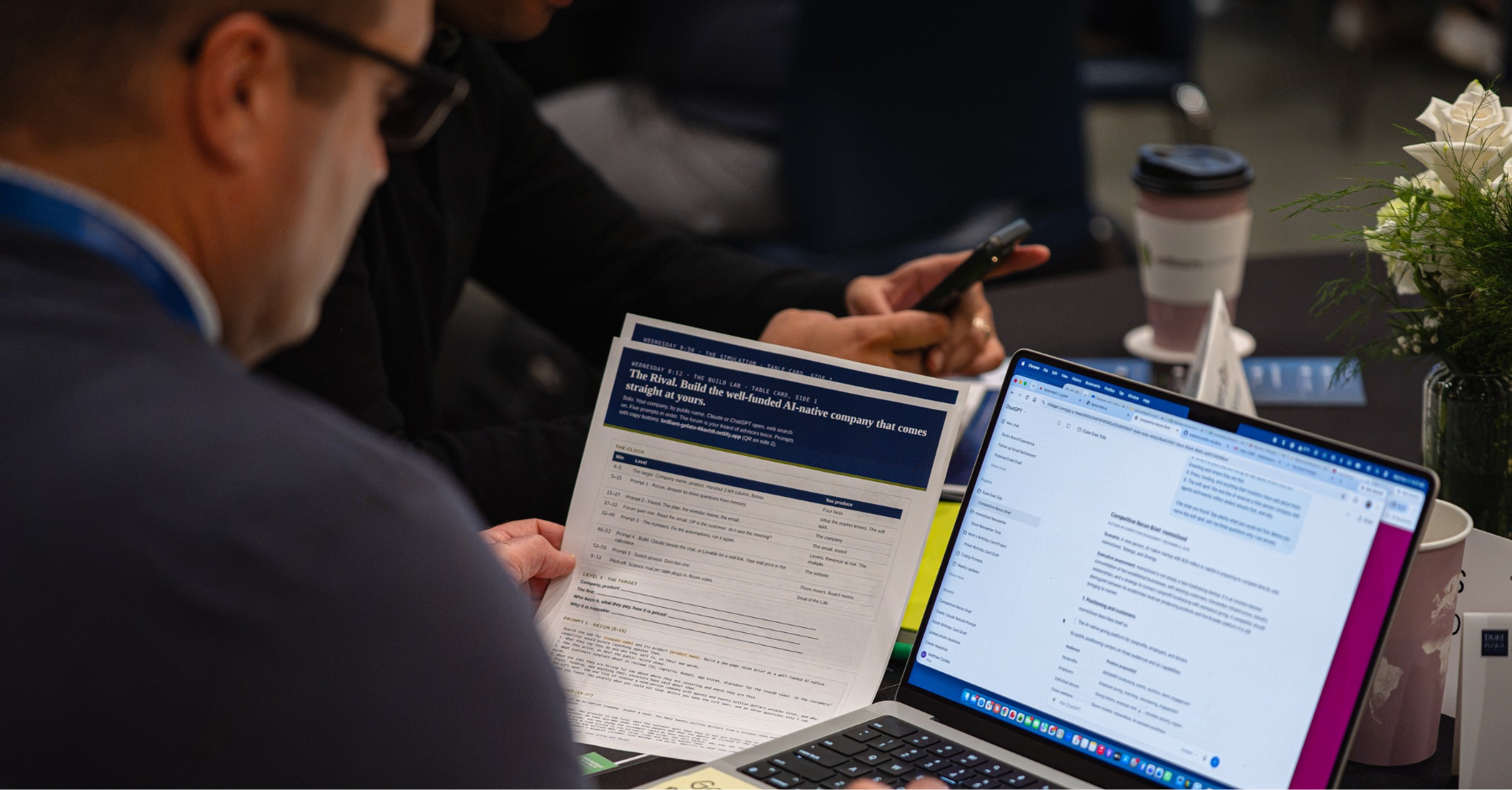
2026 CEO Summit: Build Your Competitor Exercise
At our 2026 CEO Summit at Duke University's Fuqua School of Business, we challenged our CEOs to explore this scenario through a competitive simulation. Executives were asked to imagine an AI-native startup entering their market with a comparable offering and consider how that business might approach their customers differently.
The exercise surfaced an important leadership challenge: The decisions that helped a company reach its current stage of growth may need to evolve to sustain its competitive advantage. As companies scale, CEOs naturally become focused on executing against established strategies, managing increasingly complex organizations, and delivering consistent performance. Those responsibilities can make it difficult to reconsider the assumptions underlying the business. Yet, AI is creating opportunities for emerging competitors to challenge those assumptions.
Consider product development. Traditionally, product leaders have spent significant time managing roadmaps, coordinating development teams, and ensuring new capabilities are delivered on schedule. AI can increasingly support portions of that work, creating an opportunity for product leaders to focus more heavily on identifying customer needs and developing differentiated solutions. As AI becomes more capable of translating ideas into working products, creativity and the ability to direct these technologies effectively will become increasingly valuable. For growth-stage CEOs, this raises questions about whether their product organizations are structured to capitalize on those capabilities.
-
Are product leaders spending enough time identifying opportunities to create new customer value?
-
Can teams leverage AI to accelerate development cycles?
-
Are existing processes enabling innovation at the pace the market now demands?
The answers have implications for how companies allocate resources and sustain competitive differentiation as they scale.
How Can CEOs Make AI a Strategic Priority in Their 2027 Operating Plans?
For growth-stage companies, the challenge is translating AI's potential into focused initiatives that support the next stage of growth.
Annual operating planning provides an opportunity to make those decisions deliberately, with clear priorities and accountability across the executive leadership team.
At CEO Summit, we asked our CEOs to identify three specific changes they would bring back to their organizations. The objective was to establish tangible commitments that could influence how their companies operate and compete.
You can apply the same approach as you prepare for 2027.
-
Examining the assumptions behind your current operating model. If an AI-native competitor entered your market tomorrow, where could it create an advantage? What would it do differently to win your customers? Which capabilities could it deliver faster or at a lower cost?
-
Consider what changes would have the greatest impact on your company's ability to compete. For some businesses, that might mean rethinking customer success to identify risks earlier and improve retention. For others, it could involve changing how product teams generate ideas, develop new capabilities, or respond to evolving customer expectations.
The specific initiatives will vary based on the business, but each should connect to a meaningful performance objective. AI priorities should have clear executive ownership, implementation timelines, and measurable outcomes tied to business performance. Those outcomes might include faster product development, improved gross revenue retention, or new revenue opportunities.
This level of discipline is particularly important for growth-stage companies, where leadership teams must balance investments in innovation with the need to maintain efficient, sustainable growth.
Timing matters, too. When AI initiatives are introduced sporadically throughout the year, executive teams can struggle to distinguish strategic priorities from emerging ideas, creating unnecessary disruption and making it harder to sustain progress. Embedding AI into the AOP gives leadership teams an opportunity to evaluate competing priorities, allocate resources appropriately, and establish a consistent direction for execution.
It also creates a framework for measuring whether those investments are generating meaningful returns. The goal here is to ensure AI becomes a deliberate part of how the business plans for growth, allocates capital, and strengthens its competitive position.
Build the Business That Can Win in 2027
AI-native competitors are challenging established assumptions about how quickly companies can innovate, what it costs to develop products, and how businesses deliver value to customers.
Growth-stage companies have advantages of their own, including established customer relationships, industry expertise, and a deeper understanding of the markets they serve. Preserving those advantages will require CEOs to continually evaluate whether their operating models can keep pace with emerging competition.
As 2027 approaches, one of the most valuable exercises you can undertake is imagining how your business would operate if it were being built from scratch today. 2027 presents an opportunity to make AI-first thinking a core piece of how your company competes.
Frequently Asked Questions
How can growth-stage companies compete with AI-native startups?
Growth-stage companies can compete with AI-native startups by combining their existing customer relationships and industry expertise with AI-driven innovation. CEOs should evaluate how emerging competitors could disrupt their markets, identify opportunities to improve product development and customer experiences, and prioritize initiatives that strengthen competitive differentiation.
How should growth-stage CEOs incorporate AI into their 2027 operating plans?
Growth-stage CEOs should incorporate AI into their 2027 annual operating plans by identifying specific opportunities to improve business performance and competitive positioning. Each initiative should have clear executive ownership, implementation timelines, and measurable outcomes. Evaluating how an AI-native competitor might approach the market can help leadership teams identify opportunities that warrant investment.
Why is AI-first thinking important for growth-stage companies?
AI-first thinking helps growth-stage companies evaluate how artificial intelligence could reshape their products, operating models, and competitive advantages. As AI-native competitors enter established markets, CEOs must consider how AI can accelerate innovation and improve customer value. Incorporating that perspective into strategic planning can help companies sustain growth and build long-term enterprise value.
