
-2.png)
 Jun 16, 2026

Most leaders look at revenue growth as the clearest sign of business health. Our 2026 Growth Index suggests that they're looking at the wrong metric.
Our observations across the Edison portfolio revealed that customer retention—not growth, profitability, or efficiency—is the strongest indicator of long-term financial health. The companies best positioned for durable growth are not necessarily the ones growing fastest today, but the ones whose customers continue to stay, expand, and renew.
As reflected in the chart below, Net Revenue Retention (NRR) showed the strongest relationship with overall financial performance1, followed closely by Gross Revenue Retention (GRR). Revenue growth contributed a meaningful signal, while EBITDA explained comparatively little variation in long-term financial health.
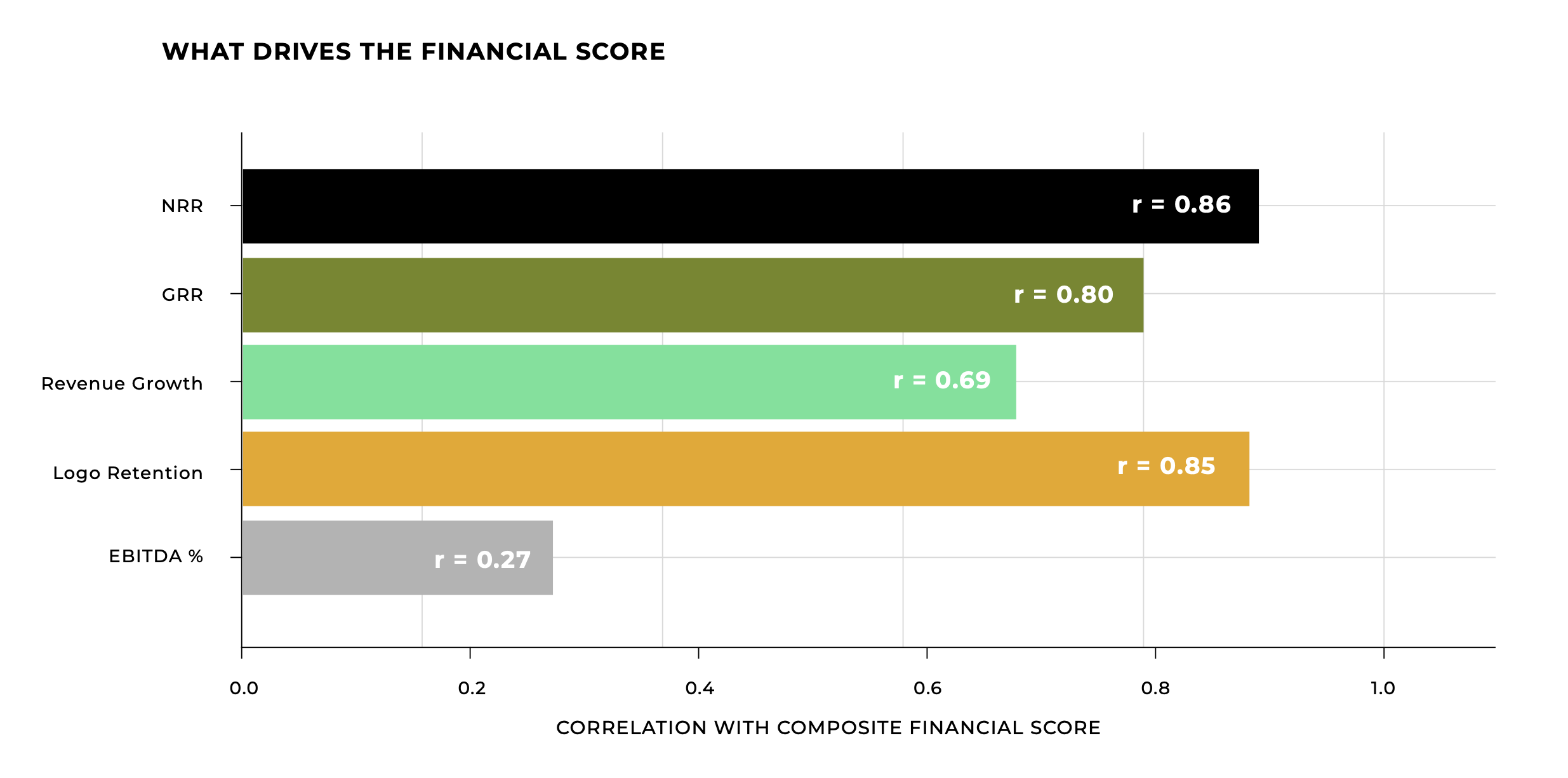
Clearly, retention captures something that growth and profitability often miss: the durability of customer value.
Survey Behaviors That Predict GRR
Across our portfolio, two specific behaviors showed meaningful correlation with GRR, the second strongest individual financial metric in the dataset: the ability to generate measurable performance gains from investment and the ability to identify and address customer health issues before they become retention risks. Combined, they create what we call the Healthy Urgency bridge: the behavioral connection between execution quality and customer outcomes. The figures below demonstrate how disciplined execution translates into stronger customer retention.
Behavior 1: Spend Performance Lift
Survey Question: "When we increase spend in a function, we see measurable performance lift within two quarters."
Correlation with GRR: r=0.56
Interpretation: Companies whose leaders believe spend converts to results actually retain revenue at higer rates.
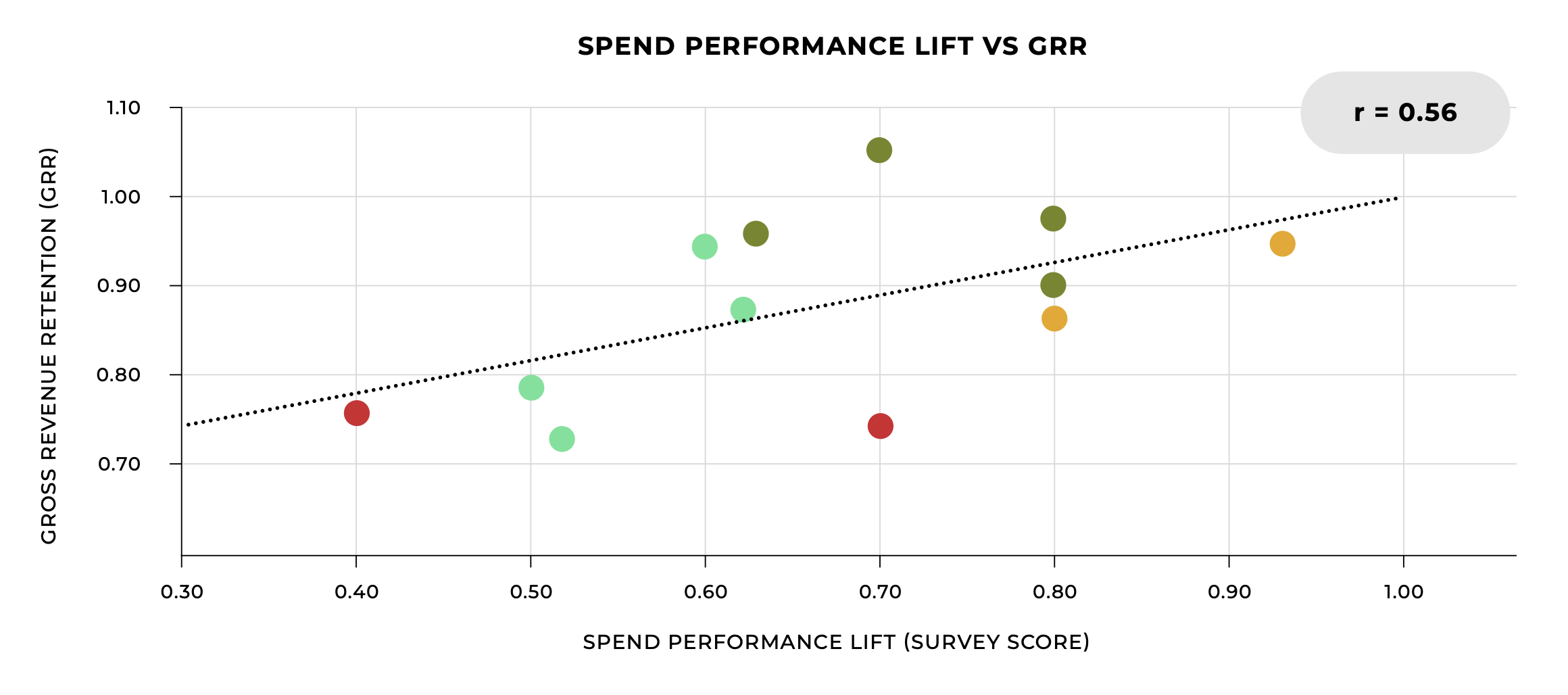
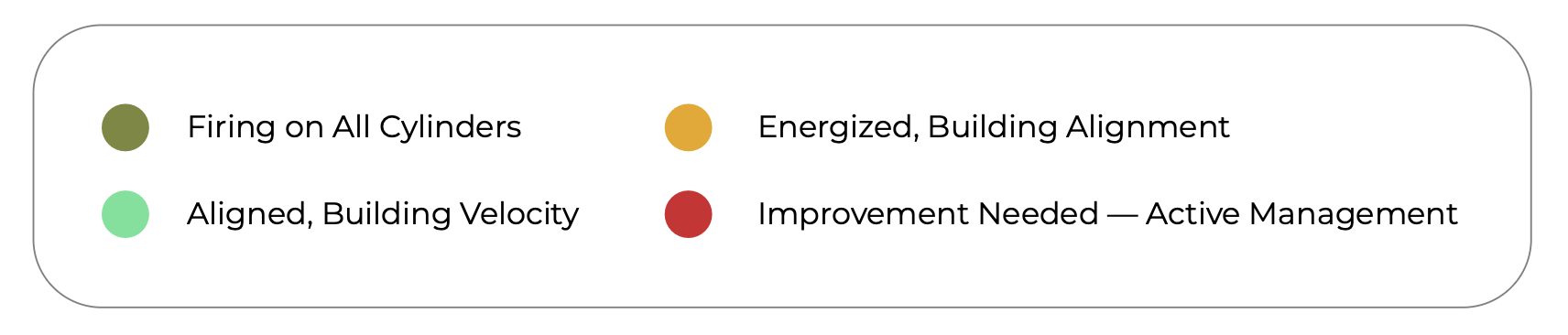
When spend is tied to measurable outcomes, customer-facing functions benefit from the same discipline.
Behavior 2: Proactive Customer Health
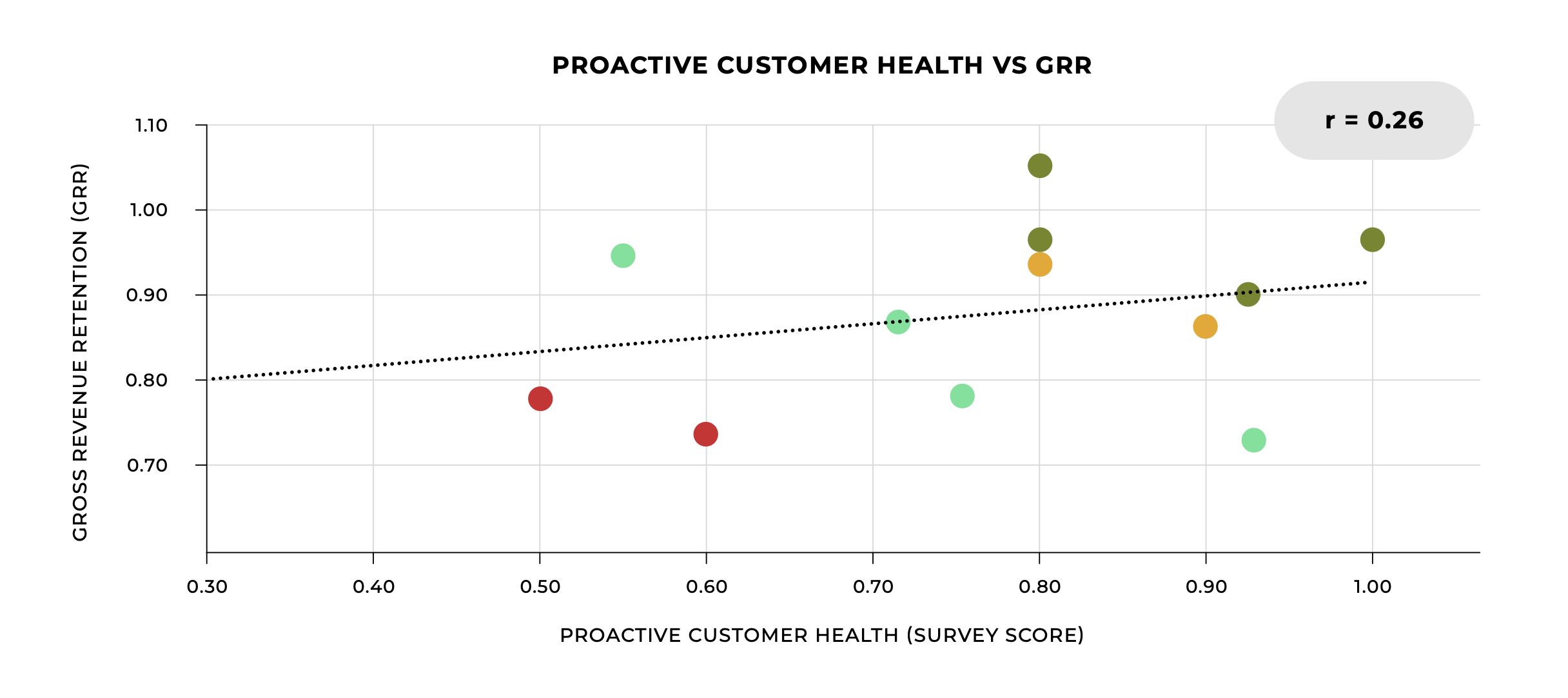
Survey Question: "Customer health signals trigger proactive action, not reactive firefighting."
Correlation with GRR: r=0.26 (standalone)
Combined with spend efficiency: r=0.59
Interpretation: Companies that manage customers proactively retain them at higher rates.
Retention as Key Differentiator
Our findings explain why two companies can post identical growth rates while operating from fundamentally different positions. In practice, companies with stickier customer bases are less prone to displacement and will have more leverage to enhance customer relationships.
Consider the following example:
Company A
- Adds new customers
- Loses many existing customers
- 30% growth rate
Company B
- Adds new customers
- Keeps almost all existing customers
- 30% growth rate
Both companies report identical growth rates. Yet Company B is more efficient because it builds on an existing base of satisfied customers. Instead of replacing lost revenue every year, it compounds.
Our findings are clear: durable growth in the lower middle market relies on retention economics > margin expansion. Anecdotally, this observation is supported by what we see in the market from buyers of companies in our portfolio. The companies with sticky customer bases are less prone to displacement, ultimately offering them an advantage to leverage AI to enhance customer relationships.
1Logo retention, tracking closely with GRR, shows high correlation but partial data coverage (79% of companies) – weighting higher world compound impact of GRR with less data coverage.

